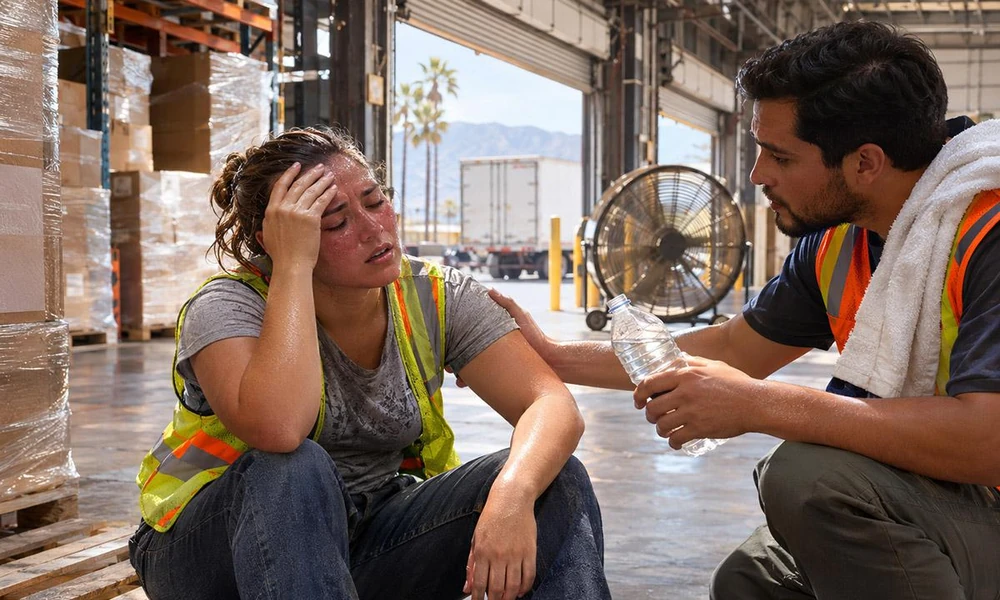
Yes, heat illness can be a covered workplace injury in California when your job caused it. Warehouses must follow Cal/OSHA’s indoor heat standard once temperatures hit 82°F, with water, cool-down areas, rest, and a written plan. Report your symptoms to your employer within 30 days, ask for a DWC-1 claim form, and get medical care. Your employer cannot legally punish you for reporting, filing, or complaining about unsafe heat.
Heat claims are dismissed faster than almost any other workplace injury, and the excuse is always the same: you were “just dehydrated.” That label is convenient for employers and insurers, because dehydration sounds like your fault. But heat illness workers’ comp in California law does not care whether you forgot your water bottle. It asks one question: did your work cause or contribute to the injury?
In the Inland Empire, that question matters every summer. Distribution centers stretch across Ontario, Fontana, San Bernardino, Riverside, and Moreno Valley. Many are giant metal boxes with loading docks open to the sun and trailers that bake on the lot all afternoon. When outside temperatures climb into the triple digits, the air inside a trailer can feel like an oven.
Workers collapse. Some go home dizzy and wake up with dark urine and muscles that won’t stop aching. Then the paperwork starts, and someone suggests it was a personal health issue.
It usually isn’t. This guide walks through why heat claims get brushed off, what California law actually requires of your employer, and how to protect your claim from day one.
Why Warehouse Heat Illness in the Inland Empire Gets Brushed Off
Heat injuries are easy to minimize because they rarely leave a visible wound. There is no broken bone on an X-ray. By the time you reach urgent care, you may have cooled down and look “fine.” That gap between how sick you felt and how you look later is precisely where a claim starts to slip.
Supervisors may tell you to sit in the break room for a few minutes and get back to it. None of that means it wasn’t a work injury.
The problem is real and documented. During a July 2023 heat wave, warehouse workers who gathered at a resource center in Ontario described coworkers suffering heat exhaustion, with one taken away by ambulance. Researchers at the UC Riverside Inland Empire Labor & Community Center have compiled studies flagging heat as a recurring hazard for local warehouse workers, including a UCLA analysis linking hotter days to more workplace injuries, even indoors.
What Heat Illness Actually Does to Your Body
Heat illness is not one condition. It is a range, from cramps and exhaustion at the mild end to heat stroke at the dangerous end. Some heat injuries, like rhabdomyolysis and kidney damage, can show up hours later and need lab tests to diagnose.
According to the CDC’s National Institute for Occupational Safety and Health, heat exhaustion often brings headache, nausea, dizziness, weakness, heavy sweating, and thirst. It happens when your body loses too much water and salt. It needs prompt medical attention, not a pep talk.
Heat stroke is a medical emergency. Signs include confusion, slurred speech, seizures, loss of consciousness, and a very high body temperature. If a coworker shows these signs, call 911 right away and start cooling them while you wait. Heat stroke can cause permanent disability or death without prompt treatment.
Rhabdomyolysis, often called “rhabdo,” is muscle breakdown tied to heat stress and hard physical work. Warning signs include muscle pain, weakness, and dark urine that looks like tea or cola. Rhabdo can strain the kidneys, and heat stress can also contribute to acute kidney injury. A doctor can order blood tests to check.
Is Heat Illness Workers’ Comp in California?
Yes. Under California Labor Code section 3600, workers’ compensation covers injuries and illnesses that arise out of and in the course of your employment. If heat at work caused or contributed to your heat exhaustion, heat stroke, rhabdo, or kidney injury, it can be a compensable claim, just like a fall or a back injury.
“Compensable” simply means the injury qualifies for benefits. In California, those benefits can include medical treatment, temporary disability payments while you can’t work, and permanent disability benefits if you are left with lasting harm. The claim does not require you to prove your employer was careless. Workers’ comp is a no-fault system.
Repeated exposure can matter too. California recognizes cumulative trauma, which means an injury that builds up over time from repeated work activity rather than one single event. If summer after summer of heat on the dock has worn down your health, that pattern may support a cumulative trauma claim.
What about a pre-existing condition like diabetes, high blood pressure, or a medication that makes you sensitive to heat? It does not automatically sink your claim. Employers take workers as they find them, and they can still cover work that aggravates a condition. That said, California uses a process called apportionment, which can reduce permanent disability benefits for the part of a disability caused by other factors. How that plays out depends heavily on the medical evidence in your case.
What Cal/OSHA Requires Inside Inland Empire Warehouses
Cal/OSHA’s indoor standard, Title 8, section 3396, took effect July 23, 2024. It generally applies when indoor temperatures reach 82°F, and stronger requirements kick in at 87°F or when other high-risk conditions exist.
According to Cal/OSHA’s indoor heat FAQ, the full requirements apply once the temperature or heat index hits 87°F. They also apply at 82°F when workers wear clothing that traps heat or work near high radiant heat. At those levels, employers must use engineering controls (like air conditioning, fans, or insulation) to cool the space where feasible.
At 82°F and up, employers must provide free, fresh, cool drinking water close to the work. If water isn’t plumbed in, that means at least one quart per worker per hour for the whole shift. Employers must also provide cool-down areas and allow rest breaks of at least five minutes whenever you feel you need one.
The rule also requires close observation of newly assigned workers for their first 14 days, since your body needs time to adjust to heat. Training must be given in a language workers understand. Employers need a written plan for preventing heat illness, available at the worksite. And they must have emergency procedures, including never leaving a sick worker alone or sending them home without offering first aid or medical help.
One detail matters on the dock. The indoor rule has a short-exposure exception, but Cal/OSHA says it does not apply to vehicles without working air conditioning or to shipping containers during loading and unloading. Hot trailers are not a loophole.
What about work outside, such as in the yard or on an open dock? The outdoor standard, Title 8, section 3395, requires shade when temperatures exceed 80°F. It also requires high-heat procedures at 95°F for certain industries, like construction, agriculture, and landscaping.
Filing a Heat Illness Workers’ Comp Claim in California
Report the injury to your employer in writing as soon as possible. California Labor Code section 5400 generally gives you 30 days to report. Then ask for a DWC-1 claim form and fill out the employee section, and return it. Get medical care and tell the doctor you got sick at work in the heat.
The Division of Workers’ Compensation says your employer must give you the claim form within one working day of learning about your injury. Once you file it, the employer must authorize appropriate treatment within one day. You can receive up to $10,000 in medical care while the claim is being decided. If the employer doesn’t deny the claim within 90 days, it is presumed covered.
Build your record early. Write down the date, the temperature, where you were working, and for how long. Note who saw you get sick and whether water or shade was available. Photos of a broken fan or an empty water cooler can provide clearer evidence than a supervisor’s memory.
Now, here’s the part your employer may not mention. California Labor Code section 132a makes it illegal to fire, demote, or punish you for filing a workers’ comp claim. Labor Code section 6310 protects you when you complain about unsafe conditions. Section 6311 says you cannot be fired for refusing work that would break safety law and create a real and apparent hazard. The Labor Commissioner handles these retaliation complaints.
Heat illness is not a personal weakness. It is a workplace injury, and California law treats it that way.
You can also file a complaint with Cal/OSHA if your warehouse is skipping water, rest, or cooling. It doesn’t pay you benefits, but it can push the employer to fix the conditions for everyone.
If the worst happens and a worker dies from heat illness at work, workers’ comp death benefits may be available to dependents, along with help with burial expenses.
Make the Heat Pay for What It Took From You
The “just dehydration” story only works if you accept it. Heat exhaustion, heat stroke, rhabdo, and kidney injuries are real medical harms. When your job caused them, California workers’ comp is designed to cover them. Report fast, get treated, and keep your record of what happened.
Our team works with injured workers across the Inland Empire, including Riverside and San Bernardino, from our Ontario office at 3200 E Guasti Road. Learn more about our workers’ compensation representation or browse our FAQ.
Been in an accident or hurt on the job? You don’t have to navigate insurance companies alone. Oracle Law Firm fights to get you the compensation, control, and clarity you deserve.
Get a Free Consultation or call 888.597.4099.
Legal disclaimer: This article provides general information about California law and is not legal or medical advice. Reading it does not create an attorney-client relationship. Every case depends on its own facts, and results are never guaranteed. If you or a coworker shows signs of heat stroke, call 911 immediately.
Frequently Asked Questions
Is heat exhaustion covered by workers’ comp in California?
It can be. If heat at work caused or contributed to your heat exhaustion, it may qualify as a work injury under California workers’ compensation. You do not have to prove your employer was at fault to file a claim.
What temperature triggers Cal/OSHA’s indoor heat rules?
The indoor heat standard generally applies when indoor temperatures reach 82°F. Additional requirements, like cooling the workspace where feasible, apply when the temperature or heat index reaches 87°F or 82°F with heat-trapping clothing or high radiant heat.
How long do I have to report a heat illness at work?
California generally requires you to report a work injury to your employer within 30 days. Reporting in writing as soon as possible is the safest approach. After that, ask for and return a DWC-1 claim form.
Can my employer fire me for complaining about warehouse heat?
No. California law protects workers who report injuries, file workers’ comp claims, or complain about unsafe conditions. You can also refuse work that would violate safety law and create a real and apparent hazard to you or coworkers.
Can I file a claim if heat made my health condition worse?
Yes, a pre-existing condition does not automatically block a claim. If work heat aggravated your condition, the injury may still be covered. Permanent disability benefits may be adjusted through apportionment depending on the medical evidence.